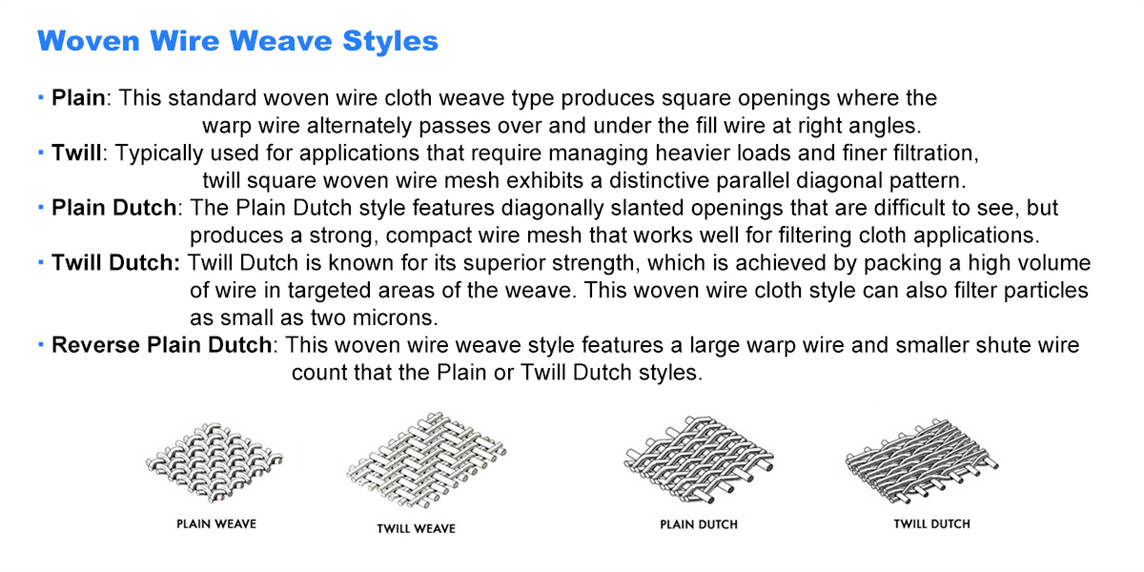
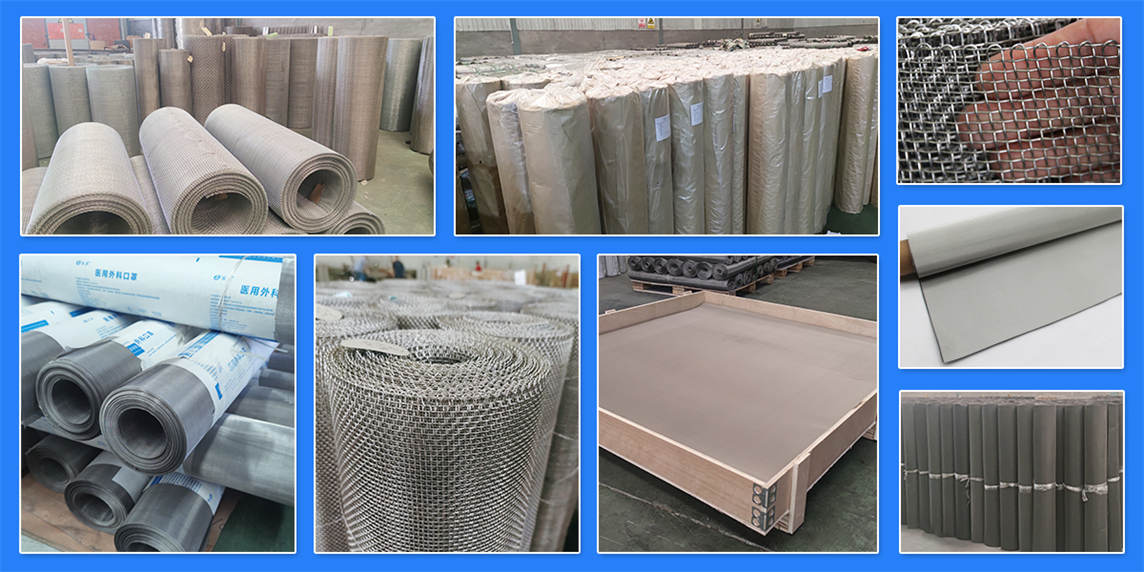
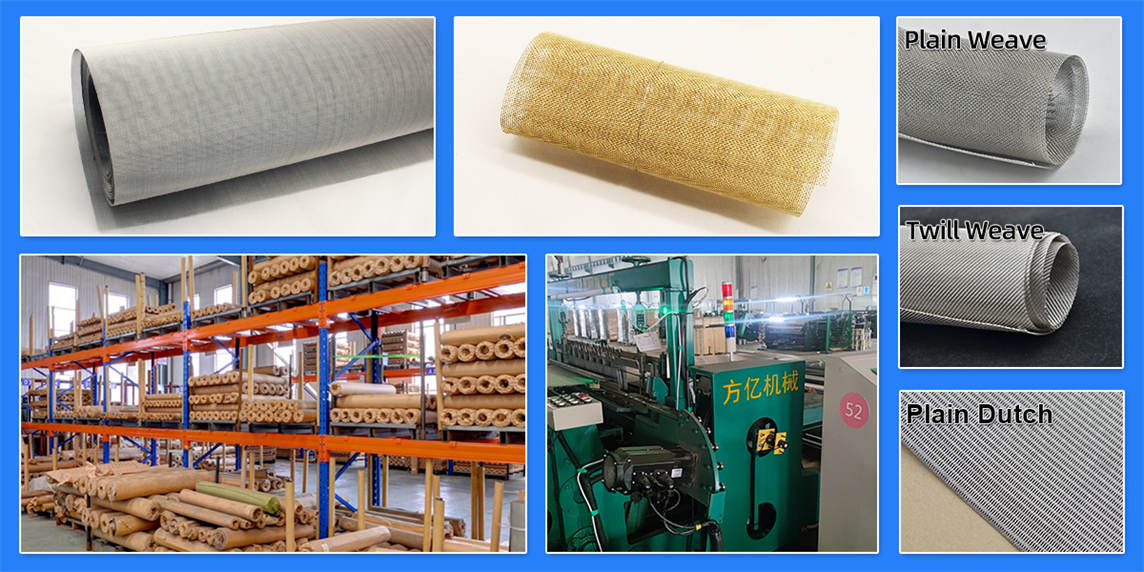
Dutch Weave Wire Mesh is also known as stainless steel dutch woven wire cloth and stainless steel filter cloth. It is usually made of mild steel wire and stainless steel wire. Stainless steel dutch wire mesh is extensively utilized as filter fittings for the chemical industry, medicine, petroleum, scientific research units, due to its stable and fine filtration capability.
Materials
Carbon Steel: Low,Hiqh,Oil Tempered
Stainless Steel: Non-Magnetic Types 304,304L,309310,316,316L,317,321,330,347,2205,2207,Magnetic Types 410,430 ect.
Special materials: Copper, Brass, Bronze, Phosphor Bronze,red copper,Aluminum,Nickel200,Nickel201, Nichrome,TA1/TA2,Titanium ect.
Good corrosion resistance: Stainless steel wire mesh is made of stainless steel, which has good corrosion resistance and can be used in harsh environments such as humidity and acid and alkali for a long time.
High strength: The stainless steel wire mesh has been specially processed to have high strength and wear resistance, and is not easy to deform and break.
Smooth and flat: The surface of the stainless steel wire mesh is polished, smooth and flat, not easy to adhere to dust and sundries, easy to clean and maintain.
Good air permeability: The stainless steel wire mesh has uniform pore size and good air permeability, suitable for applications such as filtration, screening and ventilation.
Good fireproof performance: stainless steel wire mesh has good fireproof performance, it is not easy to burn, and it will go out when it encounters fire.
Long life: Due to the corrosion resistance and high strength of stainless steel materials, stainless steel wire mesh has a long service life, which is economical and practical.
50 Micron Stainless Steel Printing Mesh
Ultra-fine aperture, minimal ink throughput. Ideal for micro PCB circuit printing, tiny electronic component conductive silver paste, ultra-fine text and micro-pattern precision printing, prevents paste overflow and ensures sharp edge definition.
100 Micron Stainless Steel Printing Mesh
Balanced precision & ink volume. Widely used for solar cell electrode printing, RFID antenna printing, thin ceramic glaze printing, electronic component resistor paste deposition. Delivers stable thin coating without frequent mesh clogging.
200 Micron Stainless Steel Printing Mesh
Medium-large opening, higher paste transfer capacity. Suitable for thick conductive paste, battery electrode slurry printing, decorative metal ceramic printing, thick film coating processes. Boosts printing efficiency for large-area uniform layers.
300 Micron Stainless Steel Printing Mesh
Coarse micron grade, maximum ink flow rate. Perfect for heavy paste printing, thermal conductive coating, solar backplate thick silver paste, industrial anti-corrosion coating screen printing, reduces squeegee pressure and speeds up mass production lines.
Q1: How to select between 50, 100, 200 and 300 micron stainless steel printing mesh?
A: Choose by printing precision and paste thickness. 50μm for ultra-fine micro patterns; 100μm for standard electronic electrode printing; 200μm for medium-thick conductive slurry; 300μm for heavy paste requiring high ink transfer volume. If you are unsure, send your ink viscosity and printing pattern drawing for our technical team’s free matching suggestion.
Q2: What’s the difference between 304 and 316L stainless steel printing mesh?
A: SUS304 suits general water-based & mild solvent ink printing with lower cost. SUS316L contains molybdenum element, stronger resistance to saltwater, strong acid and corrosive chemical pastes, ideal for marine electronics and long-cycle continuous printing production lines.
Q3: Can this stainless steel printing mesh be cut into custom sheets or mounted on printing frames?
A: Yes. We provide secondary processing services including fixed-size sheet cutting, frame welding and tension pre-stretching OEM service, saving your workshop processing labor.
Q4: Is the micron aperture consistent across the whole mesh roll?
A: All our printing mesh undergoes full-width micron inspection, aperture tolerance controlled at ±2μm, no local size deviation, ensuring uniform printing effect for full-size printing frames.